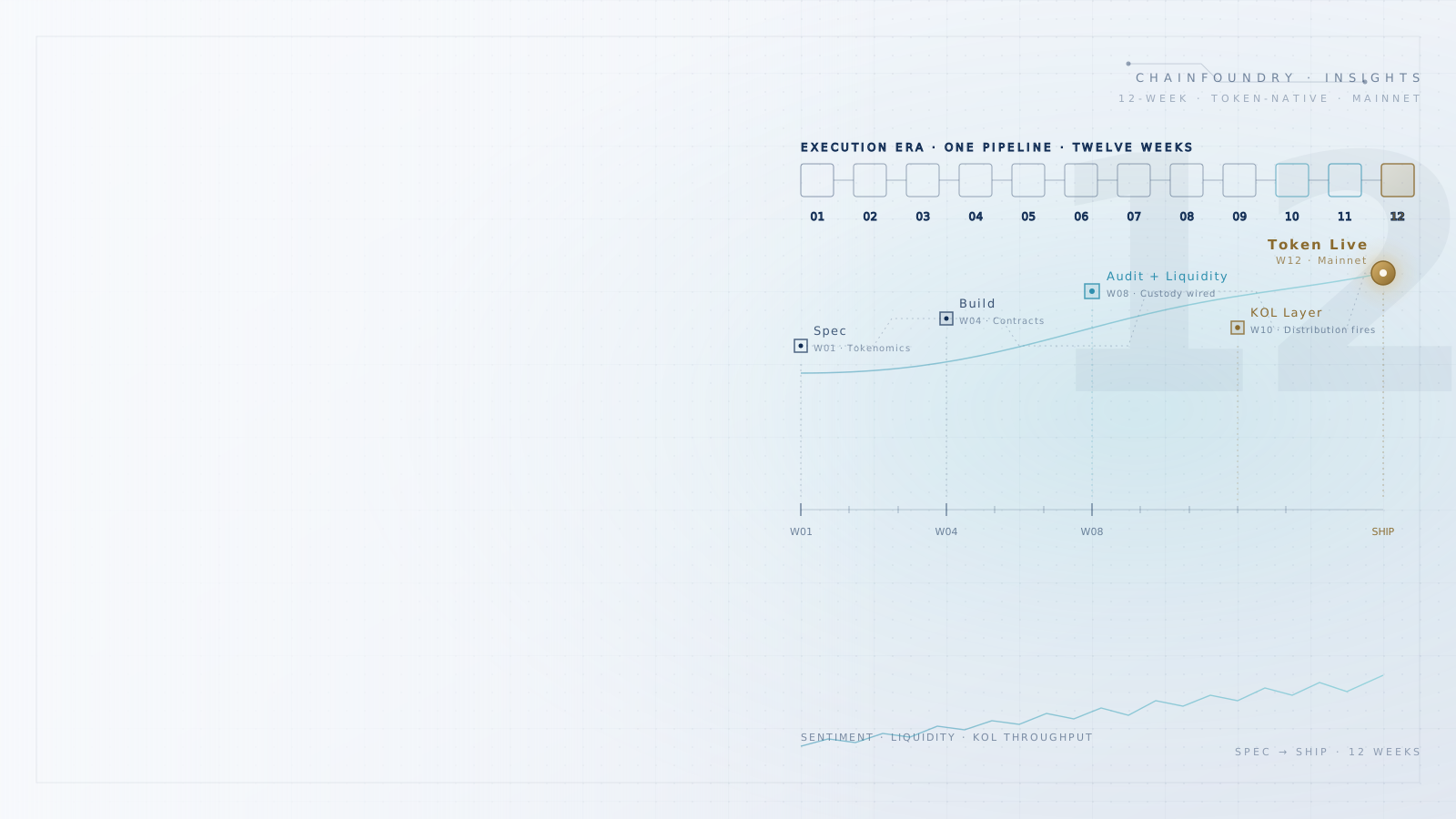
The frontier of crypto is no longer about whether a token can ship. It is about how fast, and how well, a token-native product reaches mainnet, liquidity, and a real user base. ChainFoundry was built around a single conviction: the only way to win in this market is to compress the gap between spec and ship.
That is what the foundry calls the Execution Era — a 12-week sprint that takes a project from a tokenomics whiteboard to a live product, an audited contract, a funded treasury, and a distribution layer that activates on day one.
One room, every workstream
Most teams build a token the way an early Web2 startup built a SaaS product: engineering first, then security, then growth, then — if there is anything left in the runway — distribution. In crypto, that sequence does not survive contact with the market. The audit window slips. The launch slips. The narrative dies before it begins. By the time the token is live, the moment is gone.
The foundry's response was to collapse the timeline. Inside a 12-week sprint, every workstream runs in parallel inside the same room: engineering, smart-contract, custody architecture, tokenomics, narrative, KOL outreach, exchange integration, market-making, and treasury management. Nothing is sequenced; everything is wired in from week one.
That is what makes the sprint different from a hackathon and different from an accelerator. Hackathons end with a demo; accelerators end with a deck. The sprint ends with a token live on mainnet, audited, with liquidity routed and a sentiment layer already firing.
Week 1 to Week 4: Spec and Build
The first four weeks are spent compressing the unknowns. The product team and the founder lock the spec. The tokenomics team models supply, vesting, and the incentive surface. The smart-contract team begins implementation against a frozen interface so audits can start in parallel rather than at the end. By Week 4, the protocol surface is testable and the narrative team has a working storyline that has been pressure-tested with operators inside the foundry's network.
This is also where most of the cycle's risk is killed. A token that has not been modeled by Week 4 is a token that will ship with broken incentives — and broken incentives are not a launch problem, they are a survival problem.
Week 5 to Week 8: Audit and Liquidity
The middle weeks are where execution is most visible. The audit closes. The custody architecture is wired into the foundry's institutional rails. The treasury team coordinates liquidity commitments with market-maker partners and prepares the distribution wallet topology. The narrative team begins seeding the foundry's KOL layer with positioning, ahead of any public reveal.
By Week 8, every dependency that traditionally slips a launch — audit, liquidity, custody, sentiment — is already standing. The product is no longer a candidate for launch. It is launch-ready.
Week 9 to Week 12: KOL Layer and Token Live
The final four weeks are activation. The KOL layer fires in coordinated sequence, calibrated against the sentiment telemetry the foundry runs across on-chain and social. Exchanges complete listing diligence. The treasury executes the staged liquidity plan. Validators are warmed up and integrated.
By Week 12, the token is live. The contract is verified, the liquidity is in place, the audience is primed, and the foundry's distribution flywheel — the same 100k+ ecosystem of validators, KOLs, exchanges, and treasuries — is already moving the product into circulation.
Why the model wins
The 12-week sprint is not a methodology innovation for its own sake. It is a market response. Crypto launches are won and lost in the first 72 hours of liquidity. By the time a project that took nine months to build finally lists, the cycle has rotated, the attention has moved, and the audience the team built for is gone.
By compressing the cycle to 12 weeks and parallelizing every workstream, the foundry stays inside the cycle that the founder originally bet on. Speed is not the goal. Surviving the moment is the goal, and speed is what makes survival possible.
It is also what made the foundry's 2026 build slate possible. Bullshot, B.Duck, Zappy, and OracleX were not staggered launches — they were four token-native products built in parallel through one execution system, each shipping inside its own 12-week window, each inheriting the same distribution layer.
The new operating model for token-native teams
The Execution Era is not a slogan. It is the operating model the foundry uses with every founder who walks into the building. The team in the room does not change. The cycle does not change. What changes is the product, the founder, and the market the launch is aimed at.
That is the foundry's bet: that the teams who win the next cycle will not be the teams with the longest roadmap. They will be the teams who can compress that roadmap into 12 weeks and ship a token that is audited, liquid, distributed, and held by a real audience on the day it goes live.
Published:
April, 21st 2026